Science fiction is a genre where the impossible can come to life, but it’s through our understanding of what is possible that we can expand on the impossible. Star Trek is a series that’s always had computers with insurmountable amounts of information, but someone in the 60’s is going to imagine a different computer of that sort than someone in 2020.
Similarly, while invisibility may still be in the realm of science fiction, someone in 1897 is going to imagine a different means of making someone invisible than someone in 2020. And thanks to revolutions in certain technologies, the person in 2020 would certainly have an easier time imagining that.
This ease is reflected in Leigh Whannell’s The Invisible Man, leading to a downgrade in scope. No longer a story of a scientist who terrifies a countryside and aspires to rule the world, the ease of coming up with an invisibility technology leads to a conflict in the 2020 film that is now about an everyday reality; domestic abuse.
Invisibility Then and Now in Sci-Fi
Invisibility is a conceptually pure concept that is perfect for morality tales found in science fiction and fantasy, opening us up to a multitude of narrative possibilities that I can’t possibility list in their entirety here. But at its core, invisibility in fiction breathes life into the moral quandary of who we are when no one is looking.
In fantasy, be it this generation or long ago, it’s easy to make someone invisible. Before it was retconned to become The One Ring, Gollum’s ring in the original Hobbit novel was just a magic ring that existed to help Bilbo in a tough situation. The invisibility cloak in the Harry Potter series is introduced as a Christmas present for the title character, with the primary dramatic significance being that it was once his father’s.
But H.G. Wells had a slightly tougher time in that he tried to relatively base his invisibility in reality. The key word in that last sentence is, of course, relatively, but Wells had to give his serum at least some sense of scientific grounding, plot holes be damned.
In the time since the original novel, invisibility in science fiction has become much more commonplace. Its use as a serum-free camouflage is one of the more iconic elements of the Predator franchise, is present in the more futuristic Call of Duty games, and is used on the heli-carrier in The Avengers.
Now, while I don’t know enough to suggest that this is an extremely common trope, I feel safe in presuming that wasn’t anywhere near an all-encompassing summary of technology (rather than chemically or biologically) based invisibility in modern sci-fi.
Conversely, this also isn’t to say that it’s insignificant or not “cool” to the characters in these stories.
But even just looking at the 25 year gap between the first Predator and the first Avengers, the significance is vastly different. In Predator, the technology belongs to an alien race in a first contact story. It’s completely foreign to us and baffles the characters. Meanwhile, in The Avengers, the technology is cool enough to get a money shot, and it’s believable.
Invisibility And The Old Men
The original Invisible Man film series, particularly the first two films (which are what will be most looked at), commonly explored the stakes that came with using the invisibility serum and the power that came with it. The title characters are in desperate circumstances, and if the power doesn’t get to their head, the fear of that happening is acknowledged (which is the case in the 4th film, Invisible Agent; the title character doesn’t himself go crazy, but the danger of having such power is acknowledged).
In the original film, the desperate circumstance Griffin was in was simply that he needed to make an antidote. His rude behavior to the innkeepers leads to them kicking him out, which at first reinforces his desperation and leads to him feeling oppressed. “I’m in a desperate state and they’re not letting me do whatever I want! How dare they!”
This righteous indignation (in addition, of course, to the effect the serum has on his mind) is what leads him to wanting to rule the world. He starts from a place of vulnerability, of fear, of un-recognition, and uses his tremendous scientific accomplishment as a means of fighting back against that.
Geoffrey Radcliffe (Vincent Price) follows a similar evolution in The Invisible Man Returns. He starts from a place of perceived oppression, leading to a sense of righteous indignation, and then to lust for power. However, there’s a significant difference to be found in their perceived oppression: Griffin was “oppressed” because he was rude and eventually violent to his innkeepers, whereas Radcliffe was framed for murder.
This makes Radcliffe’s eventual lust for power more tragic, or at least a different type of tragic. Griffin being a jerk from the get-go makes him a more consistent villain, whereas our sympathy for Radcliffe’s position make his lust for power more of a turn.
In both cases, the stakes of the invisibility serum are well established. With Griffin it’s reflected in his accomplishment being a tremendous feat for science, as well as the need to get the antidote.
Radcliffe’s stakes are reflected primarily in the desperation of his pre-invisibility situation. There’s still no antidote, and there’s still no choice. If he doesn’t want to die, he has to use this dangerous serum that could permanently alter his appearance and mind.
Returns also features a striking image that reflects Radcliffe’s use of the serum. He’s not a scientist who was obsessed with becoming invisible, but it’s instead a solution to the conflict plaguing his life. It’s a response to the dominant factor, not the dominant factor (at first).
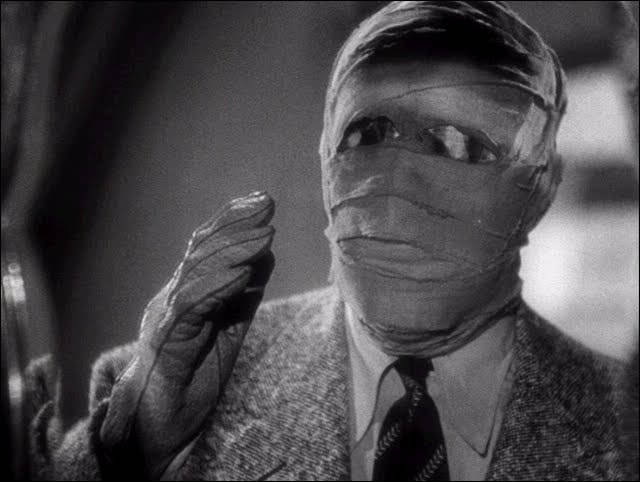
In this shot, Radcliffe is at a safe house after escaping prison, and it’s here that he properly realizes that he’s invisible. It’s an incredible moment, and speaks to the significance of achieving invisibility, even in good ol’ science fiction, back in the 40’s. It’s a moment of astonishment and horror.
Invisibility And the New Man
Whereas the invisible men in the first two films believe they’re at the bottom of the food chain and want to rule the world, Adrian Griffin (Oliver Jackson-Cohen) already has the world. From his kick-ass cars, to that mansion/fortress hybrid that he calls home, to his pretty pup named Zeus, this world leader in the field of optics seems to have it all.
All except the approval of Elizabeth Moss’ Cecilia.
She doesn’t need him, which is why the man that has everything needs her. This…contrast in emotional investment brings out the abusive side of Adrian. Controlling her every move and thought, Adrian is a man who doesn’t need invisibility serum to become a monster. His invisibility suit simply takes his monstrous nature to a new level.
This consistency of Adrian’s horror pre and post invisibility is established through the filmmaking. Throughout the entire film, the film ominously focuses on (supposedly) empty space as a means of frightening and disorienting us. Geographic understanding is a significant part of the film and its tension: we’re given an almost complete understanding of most environments we’re in as a means of reminding us that Adrian and his invisible suit could be anywhere.
The consistency comes in when Cecilia leaves him (“escapes” is the proper word). Even here, when Adrian is drugged and we know nothing of his invisibility suit, the film ominously focuses on empty space. Unlike later in the film, when we know that Adrian is somewhere in a shot but we can’t see him, there really is nothing in this empty space. It reinforces how Cecilia feels every waking moment; that he could be anywhere.
Later, after she’s escaped and learns that Adrian is (supposedly) dead, there are two scenes that speak to this consistency. The first is a scene when an unsettled Cecilia thinks she hears something at night and then searches the house she’s staying at. The majority of the scene is played out in one shot, uncertain of what she’s looking for but knowing she’s looking for something.
There’s one moment in particular that stands out, where she’s looking in the kitchen and the camera pans around her to show that the previously closed and locked front door is now open, the lock swinging from having just been removed.
The importance of this moment is how Cecilia comes across it. She doesn’t turn around and happen to come across the sight. Right before she turns around, her eyes peer to her right, as if she knows that it’s already happened.
Her attitude here is not “this is so weird, what is happening”, it’s “please don’t be true.”
When she confronts Adrian’s brother Tom (Michael Dorman), someone who she suspects (rightfully) is in on all of this, she outright says “he’s found a way to be invisible.” She has no reason to doubt what she’s saying, rightfully reasoning that the world leader in optics brother could accomplish this.
She brought along her friend James (Aldis Hodge) for this conversation, and he looks baffled and deeply concerned when she proposes this. But this concern isn’t entirely from her proposal that a world leader in optics has learned how to be invisible; it’s her proposal that a dead man is alive and has learned how to be invisible.
This is prevalent throughout the film. It’s not the invisibility technology that people have a hard time swallowing, it’s the ideas that
A. A dead man found a way to be invisible
B. A woman who murdered someone in public for all to (supposedly) see wasn’t the culprit, but an invisible man was
C. It wasn’t the man in the invisible suit that framed her, but the man who was kidnapped and tied in his basement.
And this is why Adrian did what he did. If, after her escape, he had simply started invisibly stalking her, that would have opened him up to all sorts of problems. But by faking his death, and later faking his kidnapping, he’s come up with the ultimate alibi, and the ultimate way to make her look crazy.
This is not to say that the invisibility technology isn’t presented in a cool way, or that it’s not state-of-the-art even in the film itself. It’s also not to say that invisibility technology is “real”.
But it is easy to make a realistic science fiction film about it, and to place it within an (unfortunately) everyday concept.
 devilsadvocritic